Every Singapore company must maintain a physical registered office in Singapore from day one, according to. For a founder comparing a registered address service in Singapore, the real issue is whether that address will receive and escalate ACRA, tax and court correspondence correctly. A reliable provider can offer peace of mind without requiring you to lease physical office space.
Many entrepreneurs assume that any local postal box satisfies statutory rules. However, authorities require a physical location that is open and accessible during business hours. Failing to manage statutory post can trigger compliance penalties, delayed banking approvals, or missed court deadlines.
Selecting the right provider protects your privacy and prevents administrative bottlenecks as your business expands. Your corporate legal address remains visible on public registries accessible by customers, lenders, and government agencies. A dependable arrangement ensures critical tax reminders and legal writs reach the directors immediately.
In this guide, our team evaluates provider workflows, statutory duties, and hidden exit costs. In this blog, we discuss how to select the right corporate address partner to support your venture.
Table of Contents
Why Does a Singapore Company Need a Registered Office?
Singapore law mandates that every incorporated company maintains a physical registered office address located within Singapore.
Section 142 of the Companies Act 1967 requires this address from the date of incorporation. The Accounting and Corporate Regulatory Authority (ACRA) uses this location for official communications and statutory notices. Post office boxes are strictly prohibited because an address must receive personal service of legal documents.
Furthermore, the registered office must remain accessible to the public during ordinary business hours. GoBusiness guidelines specify that the office should be accessible for at least three hours on each business day. This statutory accessibility allows government agencies, business stakeholders, and court process servers to deliver formal notices. Enterprise Singapore and GovTech outline official requirements for submitting a business address through the GoBusiness portal.
However, a registered office does not need to be your actual place of operations. A business may run operations elsewhere while maintaining a compliant address through a professional provider. You can review our range of services to see how corporate administration supports new enterprises. Importantly, having a registered office does not grant operational workspace, customer facilities, or specific commercial licences. Founders must understand the Singapore company registered office requirements before completing incorporation.
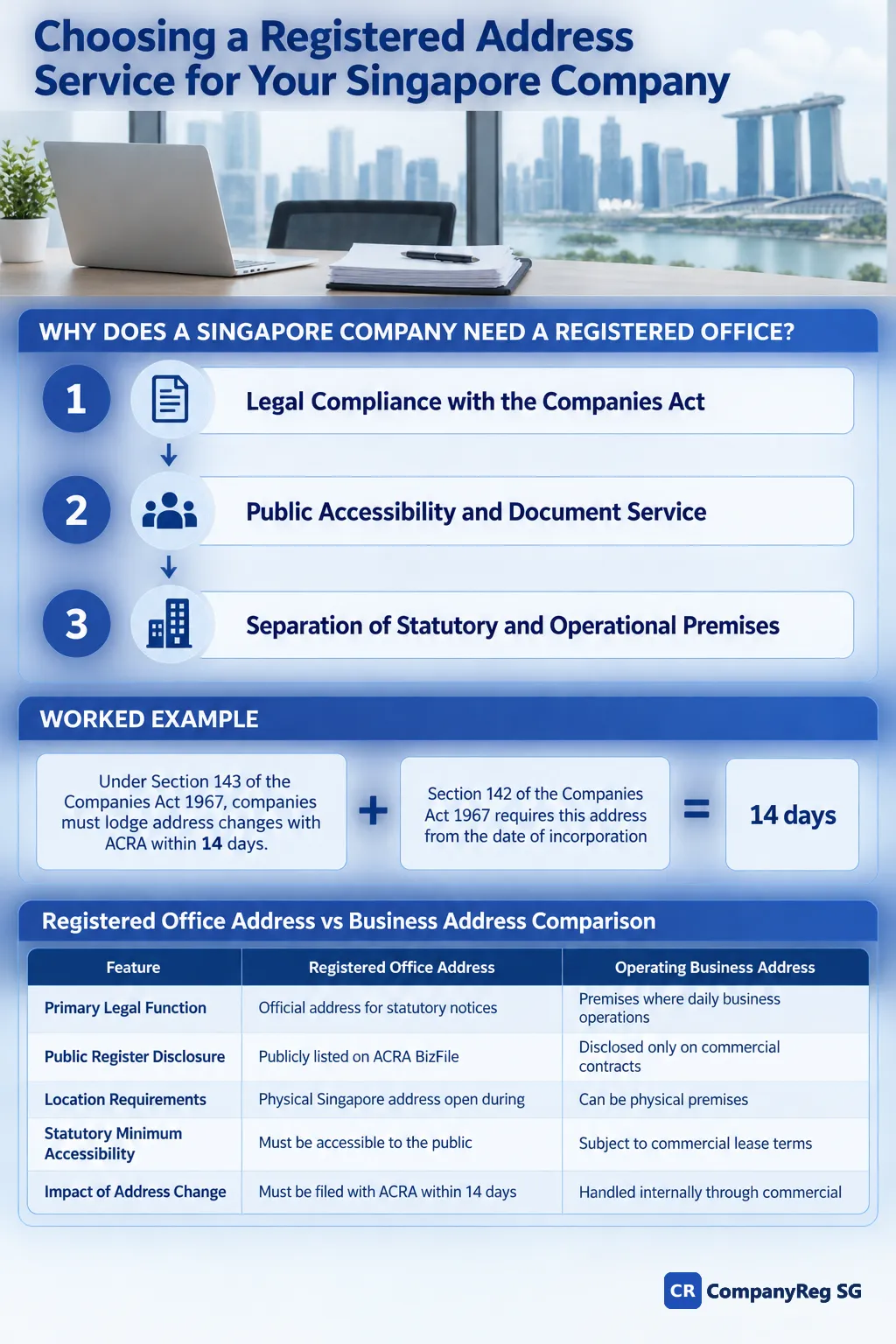
1. Legal Compliance with the Companies Act
Singapore companies must maintain a physical office address from their date of incorporation. This address receives official letters from ACRA, tax authorities, and legal representatives. P.O. boxes do not satisfy these statutory rules.
2. Public Accessibility and Document Service
The registered office must remain accessible during ordinary business hours on every business day. This ensures public officers and legal couriers can deliver notices in person. Missed deliveries can cause immediate enforcement actions.
3. Separation of Statutory and Operational Premises
Your registered office does not have to match your operating facility. You can manage manufacturing or trading elsewhere while using a corporate address for statutory filings. However, this statutory address does not grant physical trading permissions.
What Is the Difference Between a Registered Office and a Business Address?
A registered office serves as your legal address, while a business address represents where daily commercial operations occur.
Understanding registered office address vs business address Singapore distinctions helps founders avoid regulatory missteps and operational friction. A registered office address is visible on ACRA public registers and receives official notices from government agencies. In contrast, an operating address is where employees work, inventory is stored, or clients are received. A company may operate from a home, a factory, or remote locations while maintaining a separate registered office.
Many founders ask whether they can use their residential premises as the company address. Singapore allows home-based businesses under schemes run by the Housing & Development Board (HDB) and Urban Redevelopment Authority (URA). However, specific conditions apply. The business must not hire external staff at the flat, display outdoor signage, or generate disturbance.
Furthermore, using a home address exposes personal residential details on publicly searchable corporate databases. ACRA allows officers to register an alternate address for personal records for a statutory fee. However, the registered office itself remains public. In addition, co-working desk memberships often forbid using their address for ACRA registration without an upgraded corporate package. Founders should evaluate a clear practical checklist before choosing any premises.
1. Statutory Function Versus Commercial Activity
Your registered office receives correspondence from ACRA, tax authorities, and the courts. An operating address handles daily customer transactions, staff collaboration, and physical goods. These two addresses can be entirely separate.
2. Privacy Concerns and Public Records
The registered office appears on public BizFile records that anyone can purchase. Using a private home exposes personal living spaces to public searches. A dedicated corporate address maintains personal privacy for company founders.
3. Restrictions on Residential and Co-Working Options
Residential properties must satisfy HDB or URA Home Office Scheme regulations. Co-working spaces often exclude registered office rights from basic desk memberships. Always confirm written permissions before filing any address with ACRA.
Registered Office Address vs Business Address Comparison
| Feature | Registered Office Address | Operating Business Address |
|---|---|---|
| Primary Legal Function | Official address for statutory notices, ACRA filings, and court documents | Premises where daily business operations, trading, and client meetings occur |
| Public Register Disclosure | Publicly listed on ACRA BizFile and accessible to anyone purchasing business profiles | Disclosed only on commercial contracts, marketing materials, or company stationery |
| Location Requirements | Physical Singapore address open during business hours; P.O. boxes prohibited | Can be physical premises, warehouse, overseas location, or remote home setup |
| Statutory Minimum Accessibility | Must be accessible to the public for at least three hours on business days | Subject to commercial lease terms and operational preferences; regulations apply |
| Impact of Address Change | Must be filed with ACRA within 14 days to prevent statutory penalties | Handled internally through commercial contracts and customer notices |
How Should You Evaluate Mail Handling and Forwarding Workflows?
A reliable corporate address service must provide structured mail handling and fast notification protocols to protect your company.
Practitioners know that delayed mail delivery frequently leads to missed tax deadlines, banking complications, or default legal judgments. When assessing how to choose a registered address service Singapore entrepreneurs should inspect the operational workflow. Ask who receives incoming letters, how quickly notifications are sent, and whether the provider scans envelopes or contents. Reliable providers log incoming post upon arrival and alert clients promptly.
Mail opening and scanning requires your explicit written authorisation to safeguard corporate confidentiality. Without written consent, providers cannot open sealed envelopes. Document forwarding should also be clearly defined, including dispatch schedules and courier handling. In our professional practice, clear Singapore registered address mail forwarding policies ensure directors receive critical paperwork without delay.
Furthermore, ask how the facility handles registered post and courier deliveries. Some deliveries require a director's personal signature or verification, which third-party receptionists cannot provide. Bulky cargo, cash-on-delivery parcels, and perishable goods are generally excluded from standard address services. In addition, legal court documents and urgent regulatory notices must follow an immediate escalation procedure.
1. Intake Logging and Notification Timelines
Confirm how the provider logs incoming envelopes and how fast they notify you. Envelopes from statutory bodies should trigger immediate email alerts. Backup contact details ensure urgent notices reach your management team.
2. Written Consent for Mail Scanning
A provider should only open and scan correspondence under your written instructions. Clarify whether digital scanning is included in your base subscription. Transparent terms prevent unexpected fees for routine letters.
3. Delivery Exclusions and Courier Handling
Ask who possesses authority to acknowledge registered mail and track document deliveries. Standard address services routinely exclude bulky freight, perishable items, and cash-on-delivery packages. Verify these exclusions before signing any agreement.
4. Physical Office Access and Meeting Arrangements
Public accessibility under corporate law differs from booking private meeting rooms. Address subscriptions do not automatically grant customer workspaces or visitor reception rights. Clarify mail collection appointment protocols in advance.
Singapore Company Address Options Comparison
| Criteria | Home Address (HDB/Private) | Co-Working Desk Membership | Corporate Service Provider |
|---|---|---|---|
| ACRA Compliance | Requires prior approval under HDB or URA Home Office Scheme | Often prohibited under basic hot-desk or dedicated desk agreements | Fully compliant physical commercial address designed for ACRA registration |
| Director Privacy | Exposes private living quarters on publicly searchable records | Exposes shared facility address without dedicated company identification | Protects personal residential privacy by listing commercial office address |
| Statutory Mail Intake | Relies on personal residential letterbox without formal logging | Subject to shared front-desk policies and possible misplacement | Systematic intake logging, daily email notification, and digital scanning |
| Operating Restrictions | No external staff, no business signboards, no customer visits | Workspace access included, but commercial activities must fit co-working rules | Statutory address only; does not provide retail or warehouse operating space |
| Downstream Banking Trust | Banks may scrutinise residential addresses during corporate onboarding | Banks may request proof of dedicated operational space or lease | Widely recognised by corporate banks when paired with clear operational details |
How Can You Verify Record Custody and Provider Regulation?
You should verify that your address provider operates under proper ACRA registration and maintains strict document custody standards.
Understanding these regulatory boundaries ensures your company remains compliant with Singapore governance standards. First, distinguish an address service from statutory record custody. A standalone registered address agreement does not automatically mean the provider holds your statutory registers. While ACRA maintains electronic registers of members, directors, and secretaries, companies must keep minute books and internal registers. You should review our guide on understanding the role of a corporate service provider to see how statutory responsibilities are divided.
Where you engage a comprehensive company secretary service, your provider maintains corporate secretarial books and prepares statutory resolutions. Our team ensures that inspection rights for directors and members follow legal timelines. Second, verify the provider's regulatory status under ACRA. Under the Corporate Service Providers Act, entities providing corporate services in Singapore must register with ACRA as corporate service providers. This regulatory framework enforces anti-money laundering and customer due diligence standards. Engaging an unregistered entity introduces severe compliance risks for your business.
1. Custody of Minute Books and Company Registers
Do not assume an address provider automatically maintains your statutory books. Clarify whether minute books and controller registers are kept at the address. Separate custody agreements establish clear accountability.
2. Registration Under the Corporate Service Providers Act
Singapore enforces strict registration rules for corporate service providers under ACRA oversight. Providers must comply with statutory anti-money laundering guidelines. Always confirm your provider holds current regulatory registration before engaging them.
3. Inspection Rights and Legal Access
Company records must be accessible to authorised parties upon reasonable notice. Corporate regulations define who may inspect registers and statutory books. Established providers implement verified identity protocols before granting access.
Key Evaluation Criteria for Registered Address Providers
| Evaluation Domain | Critical Questions to Ask | Warning Signs and Risks |
|---|---|---|
| Mail Handling & Notifications | How quickly are envelopes logged and notified to directors? | Delayed notifications or batching urgent regulatory post into monthly mailings |
| Scanning and Confidentiality | Is written client authorisation required before envelopes are opened? | Opening mail without authority or charging exorbitant per-page scanning fees |
| Delivery Scope & Exclusions | Can the provider acknowledge registered mail and process legal notices? | Refusing official process service or failing to escalate court documents promptly |
| Statutory Record Custody | Does the package separate address services from statutory register custody? | Assuming address-only fees cover secretarial minute books and controller records |
| Renewal and Exit Policies | What notice period applies, and is address-change assistance provided? | Automatic price spikes at renewal or refusal to handle transition correspondence |
What Hidden Costs and Transition Steps Should You Plan For?
Entrepreneurs should evaluate total renewal charges, notice periods, and transition requirements before signing any registered address contract.
Headline annual fees can conceal high recurring costs for scanning, physical mail forwarding, and administrative filings. Review contract terms to understand included mail volumes and excess page charges. Some providers charge extra fees for each scanned page or incoming courier package. In addition, check the non-renewal notice period so you avoid automatic penalty renewals.
If you decide to relocate your corporate base, plan your transition carefully. Under Section 143 of the Companies Act 1967, companies must lodge address changes with ACRA within 14 days. When changing addresses, you must update downstream institutions promptly. An ACRA update does not automatically notify commercial banks, insurers, or the Inland Revenue Authority of Singapore (IRAS). Changing your registered office during a corporate bank application can trigger compliance reviews and documentation delays. Furthermore, foreign founders appointing a local representative through our nominee director service must maintain aligned records across all government channels. Always agree on a temporary mail transition period with your outgoing provider so no official letters are returned to sender.
1. Transparent Renewal Economics and Ancillary Fees
Compare base subscription rates alongside scanning limits and physical forwarding surcharges. Ensure the contract clearly lists excess charges for high mail volumes. Clear fee structures eliminate unexpected operational expenses.
2. The 14-Day ACRA Filing Deadline
Singapore companies must notify ACRA within 14 days of changing their registered office address. Failing to file timely updates attracts statutory penalties. Always confirm the new location is fully operational before submitting the change.
3. Downstream Notifications for Banks and Agencies
Updating ACRA does not automatically update commercial banks, insurers, or tax records. You must inform your financial institution, IRAS, and Ministry of Manpower (MOM) directly. Plan an overlapping mail forwarding period to avoid missed documents.
Selecting a compliant corporate address is a foundational step for every Singapore enterprise. A compliant address ensures regulatory notices from ACRA, IRAS, and the courts receive prompt attention. Distinguishing statutory office requirements from operational trading spaces protects your venture from compliance breaches and unnecessary expenses.
Carefully evaluate provider mail handling workflows, digital scanning authorisations, and transparent renewal terms before making a commitment. Reliable providers implement structured notification routines, safeguard officer privacy, and provide seamless support during address transitions.
At Company Registration in Singapore, our team at Goldhill Plaza provides complete corporate secretarial and registered office support. We help local and international founders establish fully compliant entities with dependable corporate administration. Contact us today to tailor a registered address service Singapore solution that fits your business objectives.
Establish Your Compliant Corporate Address in Singapore
Speak with the corporate services team at Goldhill Plaza to secure a reliable registered office and professional mail handling.
Frequently Asked Questions

CompanyReg SG
Singapore corporate service provider
CompanyReg SG (Company Registration in Singapore) is a Singapore corporate service provider helping local and foreign entrepreneurs with company incorporation, company secretary, registered address, accounting, tax filing and Employment Pass services.
Need help with your Singapore company?
Our incorporation specialists handle company registration, accounting, tax filing and compliance end-to-end.
Book a free consultationRelated Articles
- Can a Foreign Director Get an Employment Pass via Incorporation?
- Who Can Register a Singapore Company Remotely for Foreigners?
- Accounting for Seasonal Revenue Spikes
- Year-End Tax Planning Strategies for Singapore SMEs
- Managing Payroll Around Singapore Public Holidays
- Preparing Your Company for the AGM
Explore more on our corporate services blog or contact our Singapore incorporation team.